Tuesday, 31 December 2013

Thursday, 26 December 2013
[Announcement] Extra class
Relembro a data da aula de compensação, acordada ao longo das aulas passadas: 10/01 (sexta-feira) 9:30AM—12:30AM; 14:00—17:00. Conta-se com a comparência de todos os estudantes, a fim de se discutir o projeto 3.
———
This is a reminder of the schedule for the extra class: 10/01 (friday) 9:30AM—12:30AM; 14:00—17:00. All students are expected to attend, in order to discuss project 3.
———
This is a reminder of the schedule for the extra class: 10/01 (friday) 9:30AM—12:30AM; 14:00—17:00. All students are expected to attend, in order to discuss project 3.
Wednesday, 25 December 2013
Thursday, 19 December 2013
Wednesday, 18 December 2013
Synopsis [FINAL CALL!]
O prazo limite para o envio das sinopses é amanhã às 19:00.
———
The deadline for the synopsis is tomorrow until 19:00.
———
The deadline for the synopsis is tomorrow until 19:00.
Kaleidoscope Effect.
An unofficial music video for STAR SLINGER'S "Elizabeth Fraser (Cocteau Twins Rework)". Mostly time-lapse and video shot on a Canon XSI and GoPro with a kaleidoscope effect.
Gyu Kim-Video Art
https://vimeo.com/6923647
Idea & Concept: Gyu Kim
Camera: Gyu Kim
Video Editor & Animation: Gyu Kim
Producer: Gyu Kim
Sound Design: Johannes Oesterle
Camera: Gyu Kim
Video Editor & Animation: Gyu Kim
Producer: Gyu Kim
Sound Design: Johannes Oesterle
Gyu Kim & Johannes Oesterle 2009
Tuesday, 17 December 2013
Slit scan antes de ser slit scan
http://amnonp5.wordpress.com/2011/01/16/eternalism-the-art-of-slitscanning/
Este link fala de um dos videos que o prof apresentou na aula anterior, e aprofunda mesmo a técnica de como fazer a coisa. Códigos, programas, etc.
http://www.flong.com/texts/lists/slit_scan/#wl
Este link aborda as experiências visuais, quer na fotografia ou no vídeo, anteriores ao slit scan, por assim dizer... para quem não quer ficar preso ao slit scan, aqui tem várias alternativas de processos e técnicas.
Friday, 13 December 2013
Thursday, 12 December 2013
“Entre Espaços” é, então, uma narrativa sonora baseada na obra “Volta ao Mundo em 80 dias”. Trata-se de uma representação conceptual do novo, do desconhecido na forma de caminho, onde o Porto assume o papel de “Mundo”.
A narrativa inicia-se com uma chegada ao Porto e com um “confronto” com toda a diversidade e densidade sonora característica da cidade, quase como um choque que, ao longo da narrativa, se vai “diluindo”, dando lugar ao conhecido e permitindo ao ouvinte identificar sons mais específicos e associados à natureza; assim, os ruídos da cidade perturbam cada vez menos tornando-se familiares.
Esta deve ser assumida como uma experiência individual e ouvida num local com pouco ruído visual ou, simplesmente, de olhos fechados.
Inês de Oliveira, Ana Caspão
The Tutu Project™
"The Tutu Project™ began in 2003 as a lark. I mean, really, think of it. Me photographing myself in a pink tutu, how crazy is that?"
[Amanhã] Apresentação da publicação Mono #2 + Natal dos Experimentais
Apresentação da publicação Mono #2 + Natal dos Experimentais
Sexta-feira, 13 de dezembro
Passos Manuel, Porto
A partir das 22h30
Entrada Gratuita
# 1 / / / / / / /
———————————
Mono #2: Cochlear Poetics: Writings on Music and Sound Arts
Janeiro de 2014
Editada por Miguel Carvalhais & Pedro Tudela
Publicada por i2ADS/FBAUP
ISBN 978-989-98745-0-3
ISSN 1646-7388
248 pages
Preço especial de lançamento para a comunidade FBAUP: 6 euros
http://mono.i2ads.org
# Do editorial:
A Mono#2 compila textos originais dedicados à música, às artes sonoras e ao som nas artes e nos media. Este volume recolhe reflexões sobre teoria e prática, sobre composição, performance, técnica, virtuosismo e estética, sobre estratégias editoriais e sobre questões levantadas pelas tecnologias computacionais. Esta edição tenta mapear as práticas artísticas desenvolvidas através do som, ou que se intersectam com as artes sonoras de formas progressivamente mais complexas.
A lista de autores convidados para esta publicação incluí compositores, músicos, artistas, designers, educadores, editores e curadores. Os seus textos mapeam oportunidades criativas e ajudam-nos a descobrir novas músicas, novas formas de arte, novas formas de criar música e a melhor compreender aquelas que já povoam uma paisagem em mutação de tecnologias para a produção e o consumo de música e media sonoros.
Os textos são tecidos por um ensaio visual que parte dos seus temas e conteúdos textuais para desenvolver uma composição que atravessa todo o volume e com ele se relaciona num diálogo construtivo.
Esta Mono#2 conta com textos de Alessandro Ludovico, Enrico Coniglio, Ephraim Wegner, Francisco López, Frank Ekeberg, Heitor Alvelos, Julio d'Escriván, Leandro Pisano, Luísa Ribas, Maile Colbert, Marc Behrens, María Andueza, Miguel Cardoso, Miguel Carvalhais, Monty Adkins, Samon Takahashi e Thor Magnusson.

# 2 / / / / / / /
———————————
Esta edição do Natal dos Experimentais apresenta quatro concertos: o fonografista Luís Antero (editor da Green Field Recordings), o duo de Vitor Joaquim e João Ricardo, o trio de @c (Pedro Tudela e Miguel Carvalhais) com o baterista João Pais Filipe e ainda a apresentação das Short Stories de Pal.
Ao longo de toda a noite, estarão ainda presentes DJs da Crónica: Pedro Tudela, João Cruz, Pedro Almeida e Paulo Vinhas.
A editora Crónica, fundada em 2003, tem desenvolvido um catálogo de edições fonográficas e audiovisuais dedicado às músicas e artes sonoras experimentais e computacionais. A sua actividade tem sido reconhecida por artistas e crítica, sendo muitas vezes reconhecida como uma das mais relevantes editoras da actualidade.
A comemoração dos 10 anos de actividade contínua - com 80 edições, mais de 100 podcasts, um programa de rádio regular, vários concertos e outras atividades - serve de pretexto para a Crónica sair à rua. Depois de passar pelo Salão Brazil em Coimbra e pela Trem Azul em Lisboa, a Crónica apresenta-se agora em "casa", organizando a 9ª edição do Natal dos Experimentais no Porto.
En puntas de Javier Pérez
«Um vídeo que tirou definitivamente o conceito de inocência, pureza e graciosidade das bailarinas. Conseguiu transformar algo feminino e delicado numa dança obscura, bruta e que nos provoca arrepios.»
Tuesday, 10 December 2013

Fica aqui o nosso projecto para quem quiser ouvir.
Aconselhamos que o façam de olhos fechados e phones de forma a aumentar a capacidade sensorial e aproveitar ao máximo a experiência que quisemos transmitir! Sendo que irão ocupar o lugar da personagem principal "Jean Baptiste Grenouille" na narrativa escolhida " O Perfume, História de um Assassino."
https://soundcloud.com/hugo-ferreira-carrinho/perfumum-som
Sofia Silva, António Ramos, Hugo Ferreira
https://soundcloud.com/hugo-ferreira-carrinho/perfumum-som
Sofia Silva, António Ramos, Hugo Ferreira
[Notificação] Sinopses Projeto 3
Relembro que o enunciado do projeto 3 já se encontra disponível na respectiva página.
E ainda que até às 19:00 de quinta-feira (12/12), todos os grupos de trabalho deverão enviar por email uma sinopse do seu projeto (em PDF), para ser discutida em aula.
Bom trabalho.
E ainda que até às 19:00 de quinta-feira (12/12), todos os grupos de trabalho deverão enviar por email uma sinopse do seu projeto (em PDF), para ser discutida em aula.
Bom trabalho.
Monday, 9 December 2013
[Announcement] Lecture—Blender & Libre Animation: freedom is happening here
Palestra
Blender & Animação Livre: a liberdade está a passar por aqui
Data
Segunda-feira, 16/12/2013, às 10:00 AM.
Local
PS01 (Auditório, Pavilhão Sul), FBAUP.
Sinopse
Vivemos tempos extraordinários. "A Internet é o tecido das nossas vidas" (Castells, 2001) e está a mudar o nosso modo de viver, aprender, trabalhar, criar. Uma das mudanças mais importantes e notáveis é uma nova cultura de partilha promovida pelas redes interligadas de computadores e seres humanos. Vivemos realmente tempos extraordinários, o nascimento dos recursos digitais comuns (digital commons). Mas estes tempos não surgem sem custos e lutas. Existem perigos e riscos à espreita que se alimentam de conformismo, ignorância e preguiça.
Software proprietário, patentes de software e leis de direitos de autor excessivamente restritivas atuam como sistemas de controle e propriedade e impõem uma "cultura da permissão" (Lessig, 2004) que se esforça por obnubilar o mundo moldado pela economia da colaboração em massa, a economia da informação em rede (Benkler, 2006).
Em alternativa, Software Livre e Cultura Livre são o resultado natural de uma escolha ética em direção a uma sociedade e cultura baseadas na livre troca de ideias e criatividade, na liberdade e na partilha. São uma declaração sobre o mundo em que vivemos e a expressão de uma escolha sobre como nele queremos viver e trabalhar. Representam um ecossistema de criatividade que recusa o domínio de barreiras artificiais que beneficiam apenas alguns.
Durante esta sessão, serão apresentados exemplos para ilustrar as nossas ideias e analisados casos reais demonstrativos da viabilidade das ferramentas libre num ambiente de produção e os benefícios que acompanham a partilha e a utilização de licenças mais abertas. Iremos apresentar o Software Livre e Cultura Livre enquanto escolhas éticas e opções válidas para a animação e todas as artes em geral.
Neste contexto, o Blender emerge como um caso com interesse exemplar. A comunidade de programadores, artistas e utilizadores em geral, reunida em torno deste Software Livre desenvolvido em modelo aberto, constitui uma rede de atores com diferentes graus de compromisso e envolvimento, com diferentes motivações e interesses. Esta diversidade nas intervenções e participações sustenta um quotidiano rico e fértil que assumiu já um protagonismo incontornável no contexto da Cultura Livre.
Biografia do Orador
Nelson Gonçalves é docente no Departamento de Comunicação e Arte da Escola Superior de Educação do Instituto Politécnico de Viseu, desde 2003. É professor de diversas disciplinas, incluindo Tecnologia Educativa e Animação Multimédia. Atualmente presidente da Associação Ensino Livre, uma organização portuguesa sem fins lucrativos dedicada à promoção do Software Livre e conteúdos abertos na educação, é também membro fundador do OpenLab ESEV e do AnimaXion Studioz, um coletivo independente de animação dedicado à exploração de Software Livre e Open Source para animação. http://nafergo.intervir.net
— — — — — — — — — — — — — — — — —
Lecture
Blender & Libre Animation: freedom is happening here
Date
Monday, 16/12/2013, at 10:00 AM.
Venue
PS01 (Auditorium, South Pavilion), FBAUP.
Synopsis
We live in remarkable times. "The Internet is the fabric of our lives" (Castells, 2001) and is changing the way we live, learn, work, create. One of the most important and remarkable changes is a new culture of sharing fostered by the interconnected networks of computers and humans. We are truly living in remarkable times, the birth of the digital commons. But these times don't arise without costs and struggles. Perils and dangers lurk around and feed on ignorance, conformism and idleness.
Proprietary software, software patents and overly-restrictive copyright laws act as systems of control and property and enforce a “culture of permission” (Lessig, 2004) that obnubilates the world being shaped by the economics of mass collaboration, the networked information economy (Benkler, 2006).
Alternatively, Free Software and Free Culture are the natural result of an ethical choice towards a society and culture based on the free exchange of ideas and creativity, on freedom and sharing. They are a statement about the world we live in and the expression of a choice about how we want to live and work in it. They stand for an ecosystem of creativity that refuses the domination of the artificial barriers that benefit only a few.
During this session, we will present examples to illustrate our points and discuss real cases to demonstrate the viability of libre tools in a production environment and the benefits that accompany sharing and the use of more open licenses. We will argue for Free Software and Free Culture as an ethical and valid choice for animation and all arts in general.
In this context, Blender emerges as a case of particular interest. The community of programmers, artists and users in general gathered around this Free Software developed in an Open Source model is a network of actors with varying degrees of commitment and involvement, with different motivations and interests. This diversity of interventions and participation sustains a rich and fertile everyday life that already assumes an essential role in the context of Free Culture.
Lecturer’s Biography
Nelson Gonçalves is a teacher at the Department of Communication and Art at the School of Education of the Polytechnic Institute of Viseu, since 2003. He teaches several courses including Educational Technology and Multimedia Animation. Currently the president of Associação Ensino Livre (Free Teaching Association), a portuguese not-for-profit devoted to the promotion of Free/Libre Software and open contents in education, he's also a founding member of OpenLab ESEV and AnimaXion Studioz, an independent animation collective devoted to the exploration of Free/Libre and Open Source Software for animation. http://nafergo.intervir.net
Saturday, 7 December 2013
Vimeo Video Compression Guidelines
Vimeo Video Compression Guidelines at http://vimeo.com/help/compression.
Michel Chion References
Chion, Michel- Audio‐vision: sound on screen. New York: Columbia University Press, 1990. http://soundenvironments.files.wordpress.com/2011/11/michelchion_audio-vision.pdf.
A terminologia proposta por Michel Chion na sua obra “L'Audio-Vision” pode ser consultada at http://www.filmsound.org/terminology.htm.
A terminologia proposta por Michel Chion na sua obra “L'Audio-Vision” pode ser consultada at http://www.filmsound.org/terminology.htm.
[Notificação] Projeto 3
O enunciado do projeto 3 já se encontra disponível na respectiva página.
Até às 19:00 de quinta-feira (12/12), todos os grupos de trabalho deverão enviar por email uma sinopse do seu projeto (em PDF), para ser discutida em aula.
Bom trabalho.
Até às 19:00 de quinta-feira (12/12), todos os grupos de trabalho deverão enviar por email uma sinopse do seu projeto (em PDF), para ser discutida em aula.
Bom trabalho.
Friday, 6 December 2013
Thursday, 5 December 2013
Installation inspiration
Late installation inspiration - there's beauty in simplicity.
Rope sculptures by Moneyless
Rope sculptures by Moneyless
Saturday, 30 November 2013
Instrument that produces sound in horror movies
This percussion music instrument called Waterphone evokes the most incredible emotion and unusual responses.
The Waterphone was invented and is patented by Richard Waters. Each instrument is unique and made to order. Richard
personally makes, tunes, signs and dates each Waterphone. The sound of
the Waterphone has been compared to the haunting melodies of the
Humpback Whale and voices from inner/outer space. Waterphones have been
described as acoustic synthesizers, Waterharps, a musical "Aladdin's
Lamp", and "Whalephones".
Waterphones are in fact stainless steel and bronze monolithic,
one-of-a-kind, acoustic, tonal-friction instruments that utilize water
in the interior of their resonators to bend tones and create water
echos. In the world family of musical instruments, the Waterphone is
between a Tibetian Water Drum, an African Kalimba (thumb piano) and a
16th century Peg or Nail Violin. Each Waterphone is custom made using a
hot metal process developed over the past 40 years. The tonal rods are
tuned to a combination of micro-tonal and diatonic relationships
presented in two distinct but intergrated scales having both even and
uneven increments.
Friday, 29 November 2013
"MythBusters" - Breaking Glass With Human Voice
"VOICE/GLASS
Explanation: Early 20th-century Italian tenor Enrico Caruso could supposedly shatter champagne flutes with his high notes. No evidence exists to corroborate Caruso's claims, but physics principles side with the opera singer.
Clink a wine glass with a fork, and the high-pitched tone you hear is its natural resonance. Every object possesses a natural resonance, or a specific frequency, that causes it to vibrate. Therefore, when the fork vibrates the glass, the natural resonance sings out. A human voice could theoretically shatter that same glass by matching its high-pitched natural resonance tone, potentially producing vibrations powerful enough to break it.
MythBusters Jamie Hyneman and Adam Savage put those physics principles in motion by recruiting a trained vocalist to break some crystal glasses. They picked crystal due to its fragile structure and also hand-picked glasses with clear, ringing natural resonance notes that would be easier for the vocalist to strike.
Demonstrating the piercing power of the human voice, the singer not only broke glasses with an amplified voice, but also without any acoustic enhancements. For final myth confirmation, untrained Adam Savage also shattered a glass, while everyone's eardrums miraculously escaped intact."
Fontes:
Video: http://www.youtube.com/watch?v=ybcEv3Fi4RA
Texto: http://dsc.discovery.com/tv-shows/mythbusters/mythbusters-database/human-voice-shatter-glass.htm
Austríaco inventa aparelho para controlar som vindo do exterior
"Imagine que mora em pleno zona de animação noturna, numa casa antiga sem qualquer tipo de isolamento sonoro. Dormir pode ser uma missão quase impossível, mas é para casos desses (mas também para quem tem o sono leve) que o prático dispositivo de 'eliminação' de som ambiente, o "Sono", foi idealizado.
Trata-se de um conceito criado pelo designer austrícaco Rudolf Stefanich para ser o mais personalizável possível, ou seja, dar ao utilizador a hipótese de escolher os sons que quer e não quer filtrar. O dispositivo coloca-se na janela do quarto e funciona de acordo com o mesmo princípio que faz com que os auriculares protegem os ouvidos de ruídos externos.
O som consiste em ondas que se propagam pelo ar. Ao atravessar um dado elemento, essas ondas causam vibração consoante o tipo de objeto com que entram em acção. Para anular os sons que procuram passar pela janela, é necessário que, a partir do interior, outro aparelho produza vibração no vidro, por exemplo. Se o princípio se comprovar, as vibrações anulam-se e o som ambiente do exterior não atravessa para o quarto.
Não se dirija é já à loja mais próxima para comprar o "Sono", o aparelho ainda não passou da fase de protótipo. Já foi testado por Rudolf Stefanich, e teve sucesso em filtrar sons até 12 decibéis e sons mais suaves até 80 decibéis.
O dispositivo é agora finalista do James Dyson Award, um dos concursos de design mais importantes do mundo, mas ainda falta um longo caminho a paercorrer até esta ideia poder ser algo mais tangível e disponível para produção em massa. "
Ler mais: http://expresso.sapo.pt/austriaco-inventa-aparelho-para-controlar-som-vindo-do-exterior=f843237#ixzz2m3O7ixt6
Kreng
http://www.humanworkshop.com/index.php?modus=music&sub=artists&item=krenghttp://www.youtube.com/watch?v=0GSz1i_aWlQ&list=PL11A0C1CA90F62429

"Kreng started out as a strictly sample-based project, incorporating sounds from various sources: free-jazz, new electronic generated sounds, classical modernism & vintage geographical recordings. The project became a very cinematic, theatrical device that has been used by various directors. Kreng has now scored more that 15 theatre- & danceproductions, most of them produced by Abattoir Fermé’s director Stef Lernous & free-lance man Piet Arfeuille."
"Kreng started out as a strictly sample-based project, incorporating sounds from various sources: free-jazz, new electronic generated sounds, classical modernism & vintage geographical recordings. The project became a very cinematic, theatrical device that has been used by various directors. Kreng has now scored more that 15 theatre- & danceproductions, most of them produced by Abattoir Fermé’s director Stef Lernous & free-lance man Piet Arfeuille."
Tuesday, 26 November 2013
"Another peak at the creation of Amnesia: The Dark Descent. This time Tapio, of kaamossound.com, gives a demonstration of how he created the sounds heard in the game. Tapio specialized in making the sounds for the visions and the monsters you'll encounter in tomorrows release of Amnesia!
http://amnesiagame.com
Release on the 8th of September 2010."
Saturday, 23 November 2013
WWF Parallax sequence
« (...) Feito apenas com fotos, mas compondo uma cena de vídeo. No final, cada cena no vídeo é feita a partir de uma única foto.
O segredo está na manipulação de fotos. Cada imagem foi processada no Photoshop, separando os diferente elementos em suas próprias camadas, então exportaram essas camadas para um programa de edição de imagens, onde cada uma delas recebeu uma animação, criando velocidades.(...) »
Thursday, 21 November 2013
Coisinhas caseiras
Criar sintetizadores em casa, dá. Dá trabalho e pior que isso, é preciso muito tempo, pelo que para a proposta talvez não resulte, talvez....
http://nicksworldofsynthesizers.com/
http://nicksworldofsynthesizers.com/
Tuesday, 19 November 2013
[Announcement] Project 2 deadline
For anyone that missed the last class: there's no class this friday, 22/11, and the next is on the 29/11. Taking this into account, the deadline of project 2 was postponed to 6/12.
pc.
pc.
Sunday, 17 November 2013
Saturday, 16 November 2013
Friday, 15 November 2013
Floss Manual - Audacity
Aqui fica o link para o Floss Manual onde podem fazer download do pdf com um tutorial para o Audacity.
http://flossmanuals.net/audacity/
http://flossmanuals.net/audacity/
Massive Attack's "Teardrop" performed on vegetables
Pretty much one of the most creative ways for recording sound.
Thursday, 14 November 2013
Audacity

Audacity is a free, easy-to-use, multi-track audio editor and recorder for Windows, Mac OS X, GNU/Linux and other operating systems. The interface is translated into many languages. You can use Audacity to:
- Record live audio.
- Record computer playback on any Windows Vista or later machine.
- Convert tapes and records into digital recordings or CDs.
- Edit WAV, AIFF, FLAC, MP2, MP3 or Ogg Vorbis sound files.
- Cut, copy, splice or mix sounds together.
- Change the speed or pitch of a recording.
- And more! See the complete list of features.
Wednesday, 13 November 2013
Thierry de Mey - "Table Music"
Thierry De Mey, born in 1956, is a composer and filmmaker. An instinctive feel for movement guides his entire work, allowing him to tackle and integrate a variety of disciplines. The premise behind his musical and filmic writing is the desire for rhythm to be experienced in the body or bodies, revealing the musical meaning for the author, performer and audience. He has developed a system of musical writing for movement used in pieces where the visual and choreographic aspects are just as important as the gesture producing the sound. A large part of his music production is intended for dance and cinema. He has often been more than a composer for the choreographers Anne Teresa De Keersmaeker, Wim Vandekeybus and his sister Michèle Anne De Mey.
Instruções de como fazer o microfone de contacto e o hidromicrofone
Microfone de contacto (vídeo da aula)
Hidromic
Microfone de contacto (vídeo da aula)
Hidromic
Monday, 11 November 2013
Sonorização
A sonorização é um trabalho de reconstrução de sons que não puderam ser devidamente captados durante a produção de um filme. Essa reconstrução utiliza todo tipo de materiais, espaços e acções de forma a obter os sons, ruídos e texturas desejados, exigindo bastante criatividade.
Thursday, 7 November 2013
[Announcement] P02-Grupos
Relembro que a constituição de cada grupo de trabalho para o projeto 2 deverá ser comunicada por email até ao dia amanhã!
Bom trabalho.
Bom trabalho.
Tuesday, 5 November 2013
Pedro Junqueira Maia
http://www.youtube.com/watch?v=lb46pLs065c
PEDRO JUNQUEIRA MAIA
'XCUSE ME WHILE I KISS THE SKY [2010]
(hommage to John Cage and Jimmi Hendrix)
[for percussion, electric guitar and electronics
interpretação / performance NUNO AROSO
electrónica / electronics Pedro Junqueira Maia
PEDRO JUNQUEIRA MAIA
'XCUSE ME WHILE I KISS THE SKY [2010]
(hommage to John Cage and Jimmi Hendrix)
[for percussion, electric guitar and electronics
interpretação / performance NUNO AROSO
electrónica / electronics Pedro Junqueira Maia
Justin Boyd: Sound and Time
http://vimeo.com/78213028
Justin Boyd, Department Chair of Sculpture and Integrated Media at Southwest School of Art, shares his connection with sound and how he uses it to create original works of art. Inspired by his sensitivity to sound at a very young age, Boyd has been recording and working with sound and music since the mid 90s. Boyd actively captures field recordings for integration of sound with found objects. This documentary was produced in association with Southwest School of Art. Learn more about their BFA program at swschool.org.
Justin Boyd, Department Chair of Sculpture and Integrated Media at Southwest School of Art, shares his connection with sound and how he uses it to create original works of art. Inspired by his sensitivity to sound at a very young age, Boyd has been recording and working with sound and music since the mid 90s. Boyd actively captures field recordings for integration of sound with found objects. This documentary was produced in association with Southwest School of Art. Learn more about their BFA program at swschool.org.
Saturday, 2 November 2013
Virtual Barber Shop
Barbeiro virtual: uma experiência sonora tridimensional com um toque de humor.
Extra: deixará de haver música original? Descubra aqui.
Tentative Call to the Other (2010) - installation
Architectural Sound installation with Ali Momeni for DYNASTY (June 10-September 5, 2010) commissioned by Musée d’Art Moderne de la Ville de Paris with support from the Council for Artistic Creation and the City of Paris.
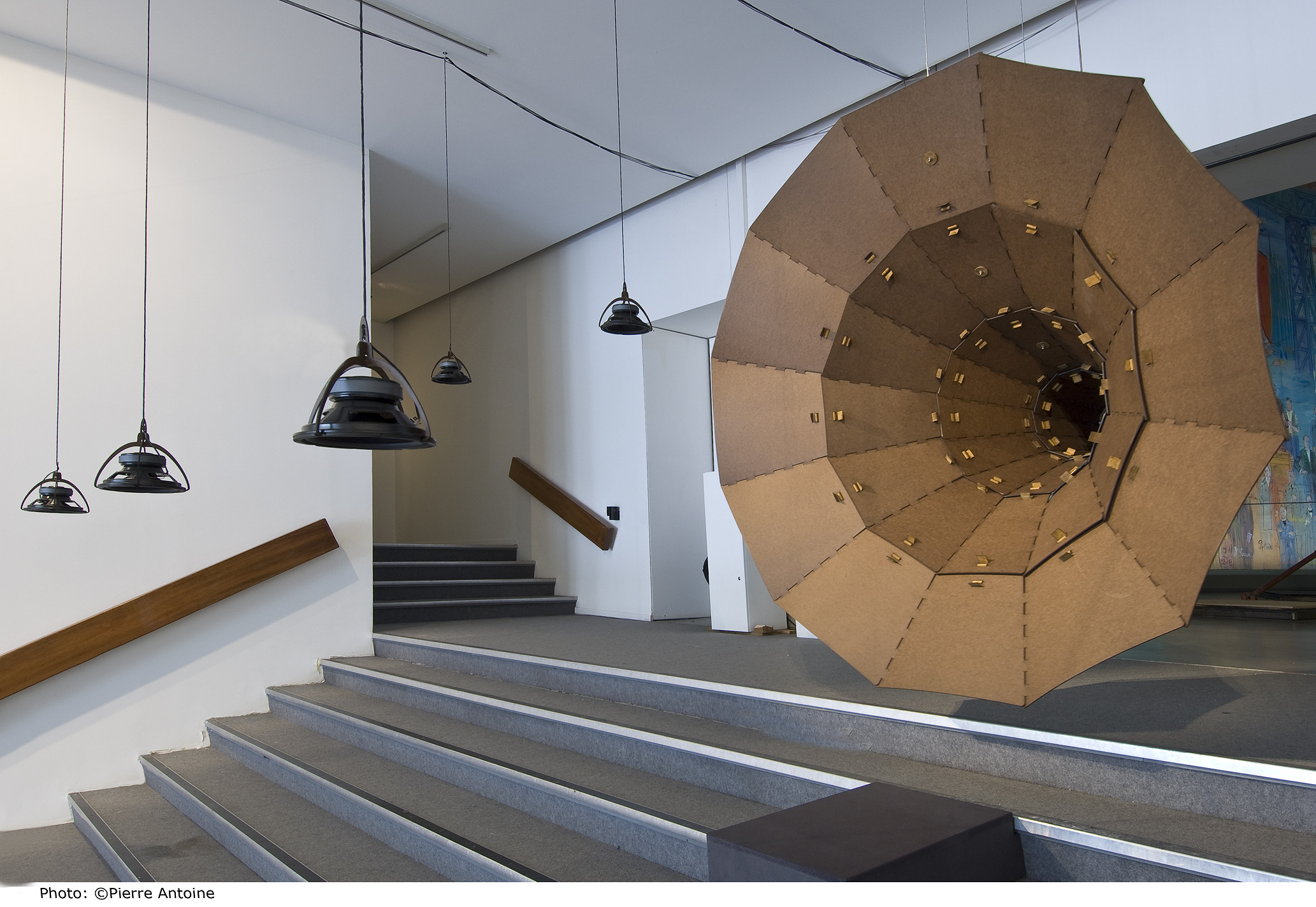
A Tentative Call to the Other consists of a forest of suspended loud-speakers as well as a large speaker nearly 2m in diameter. The installation is situated at the entrance of the Dufy Hall at the Musée d’Art Moderne in Paris.
Within this immersive sonic environment, the visitor discovers the barrage of electromagnetic activity that surrounds us. Invisible but omnipresent, these signals are picked up with a special antenna placed on the roof of the museum. In parallel with the sonified electrical activity, visitors also hear sounds originating in outer space, picked up by ESA’s CoRoT Satellite, that are made audible in real-time thanks to a collaboration with Eric Michel from the Paris Observatory.
The diffusion of these sounds is punctuated by interviews with astrologers, hymns, and incantations of ritualistic prayers in Southeast Asian languages. This installation thus offers a contemporary reinterpretation of the painted mural by Raoul Dufy, La Fée Electricité (1937), itself a commentary on the impact of the urban electric grid human society.
Friday, 1 November 2013
Contact Mic
http://abduzeedo.com/sound-design-contact-mic-recording-and-water-foley
Concept: "Contact Mic Recording is a form of microphone specifically designed to pick up audio vibrations in solid objects. Normal studio mics are all built around the principle of detecting vibrations in the air but Contact mics are different in that they are designed to pickup surface vibrations."
http://vimeo.com/31926631
Thursday, 31 October 2013
Música feita através de samples
Os Coldcut são uma banda electrónica formada por Matt Black (programador informático) e Jonathan More( ex professor de artes) que se fazem servir para além da utilização de vídeos e da multimédia, de cut ups retirados de gravações de falas, sons do quotidiano e samples de hip hop e jazz. Esta banda participou activamente durante toda a sua longa carreira com um grande número de artistas que vão muito para além da área da música.
http://ninjatune.net/artist/coldcut
Ice Bellows - Installation art by Nikki Pike
| "ICE BELLOWS (REMIX) |
| Ice Bellows (remix) began as a study of silence. The initial inquiry set out to capture the sound of ice melting to then amplify such subtlety, but the sound of ice as it melts became fascinating. In the process of amplification, the aural experiment grew quickly away from silence and shifted into a discovery of sound as the ice revealed a musical quality. The sounds came to life in the way Bjork performed a sort of factory musical in the feature Dancer in the Dark - each machine working together to create a composition. After analyzing and organizing the recorded sounds, a visual interface was erected. Viewers were then invited to manipulate these sounds through a simulated pipe organ. Thus, the viewer becomes the artist. Concurrently, a musical collaboration of the same sounds was in process with local jazz musician,Dan Schwindt. He arranged the captured sounds of ice melting to make a unique composition that serves as a foundational soundscape throughout installation and exhibit." Fonte: http://www.nikkipike.com |
Sound Waves: "The Nature of Sound" 1948
"Boy uses his radio equipment to demonstrate how sound is produced and transmitted."
Sound
is a mechanical wave that is an oscillation of pressure transmitted
through a solid, liquid, or gas, composed of frequencies within the
range of hearing.
Sound also travels through plasma...
Propagation of sound
Sound
is a sequence of waves of pressure that propagates through compressible
media such as air or water. (Sound can propagate through solids as
well, but there are additional modes of propagation). Sound that is
perceptible by humans has frequencies from about 20 Hz to 20,000 Hz. In
air at standard temperature and pressure, the corresponding wavelengths
of sound waves range from 17 m to 17 mm. During propagation, waves can
be reflected, refracted, or attenuated by the medium.
The behavior of sound propagation is generally affected by three things:
-
A relationship between density and pressure. This relationship,
affected by temperature, determines the speed of sound within the
medium.
- The propagation is also affected by the motion of the
medium itself. For example, sound moving through wind. Independent of
the motion of sound through the medium, if the medium is moving, the
sound is further transported.
- The viscosity of the medium also
affects the motion of sound waves. It determines the rate at which sound
is attenuated. For many media, such as air or water, attenuation due to
viscosity is negligible.
When sound is moving through a medium
that does not have constant physical properties, it may be refracted
(either dispersed or focused).
" The Guide To Sound Effects
Tips and ideas for making your own sound effects
Airplane engine, flying (WW2 style)
Get some of the larger fan types into your studio and record different speeds and power up/downs, close miked. You’ll have to add some distortion and remove some of the lower end depending on the type of fan used.
- Jonathan vd Wijngaarden
- Jonathan vd Wijngaarden
Alien egg sacks
A good one for alien egg sacks contracting and expanding is breathing softly into a styrofoam cup while pressing it in and out.
- Pedro Seminario
- Pedro Seminario
Alien pod embryo expulsions etc.
Certain kinds of canned dog food make useful sounds as the food comes out of the can. The chunky stuff isn’t so good, but the tightly packed all-one-mass kind makes gushy sucking sounds when the air on the outside of the can is sucked into the can to replace the exiting glob of dog food. This sound can be used as an element in certain kinds of monster vocalizations, alien pod embryo expulsions, etc.
- Ashley Walker
- Ashley Walker
Arrow flyby
Use a thin bamboo stick, such as the type used to hold up plants in a garden. Whip it past the microphone.
- Adam Johnson
- Adam Johnson
Bats flying
I used an umbrella opening and closing rapidly for the sound of bats flying one time… turned out great. I think I had to filter out some of the low frequency material, though.
-Tim Clarke
-Tim Clarke
Blood and guts being torn out
I know how to make a nice sound of blood and guts being torn out. Just make a milk pulp and put it into your mouth, and they try to say “Ghhhh”. Mix it with the end section of any splash water sample or add a sample where you’re moving out your hand from the barrel of water :)
- Adam
- Adam
Blood rushing in veins
For the blood sound I use the sound of a sponge that I squeeze into water (with a hydrophone) to make the air come out, then I pitch down a bit. I would also add white noise under it to give it a bit of high.
- Rodrigue Amyot
- Rodrigue Amyot
Try putting a microphone into your mouth. You will get a nice low end sounding like blood. You will have to try to avoid making clicking sounds with your mouth.
- Morten Green
- Morten Green
Blow to the head
Now I’ve heard, (and I’m not saying it’s true but…) if you get a water melon, stick cream crackers to it (Jacob’s or Sainsbury’s own) and then whack it with a hammer/axe it sounds very much like you would expect a similar type blow to the head. You can then bury the water melon under the patio and no-one need ever know.
- Nick Arundel "
- Nick Arundel "
...
Publicado por: Ana Margarida Pereira
"http://www.ted.com Playing sound effects both pleasant and awful, Julian Treasure shows how sound affects us in four significant ways. Listen carefully for a shocking fact about noisy open-plan offices.
TEDTalks is a daily video podcast of the best talks and performances from the TED Conference, where the world's leading thinkers and doers give the talk of their lives in 18 minutes. TED stands for Technology, Entertainment, Design, and TEDTalks cover these topics as well as science, business, development and the arts. Closed captions and translated subtitles in a variety of languages are now available on TED.com, athttp://www.ted.com/translate. Watch a highlight reel of the Top 10 TEDTalks at http://www.ted.com/index.php/talks/top10
Join Live Conversation with the speaker Julian Treasure on What a conscious listening world be like and how do we get there? October 10th, 1pm - 2.30 pm EDT, athttp://www.ted.com/conversations/6084..."
http://www.youtube.com/watch?v=rRepnhXq33s
As principais diferenças entre formatos de audio
Quem viveu o final dos anos 90 na Internet sabe o rebuliço que o MP3 causou. Naquela época, em que o Napster era a principal maneira para conseguir uma música na Internet, muitos artistas, incluindo o Metallica, se voltaram contra ao programa P2P, já que, na perspectiva do artista, afetava a venda de seus discos.
Passados quase dez anos, a música digital continua em alta na rede. Hoje, várias bandas e artistas... Continuar a ler...Som do terramoto no Japão
Este é o som do terremoto que atingiu o Japão em março passado, 11. Universidade Politécnica de Catalunya (UPC) obteve isto graças a gravação com as informações fornecidas por uma rede de observatórios submarinos localizados em ambos os lados do epicentro, localizado próximo à cidade japonesa de Hatsushima.
Universidade Politécnica de Catalunya (UPC) tinha uma gravação de som do terremoto no Japão, graças às informações fornecidas por uma rede de observatórios submarinos localizados em ambos os lados do epicentro, localizado próximo à cidade japonesa de Hatsushima.
O som do terramoto e suas réplicas foram capturados pelo sistema LIDO, equipada com hidrofones esse registro, em tempo real e online, os sons do fundo do mar. Dados fornecidos pela Acoustic LIDO ter sido acelerado 17 vezes, a fim de ser ouvido por ouvidos humanos.
O som do terramoto e suas réplicas foram capturados pelo sistema LIDO, equipada com hidrofones esse registro, em tempo real e online, os sons do fundo do mar. Dados fornecidos pela Acoustic LIDO ter sido acelerado 17 vezes, a fim de ser ouvido por ouvidos humanos.
Pulsu(m) Plantae _ project presentation
Artist Leslie Garcia has used transducers and amplifiers to translate the "language" of plants into sounds audible to the human ear.

In 1949, Roald Dahl wrote a short story called "The Sound Machine". In it, a man invents a machine that allows him to hear the sounds inaudible to humans due to their frequency outside the range of hearing, and discovers that plants do, in fact, make sound in response to the world.
Artist Leslie Garcia's "Pulsu(m) Plantae" has not, in fact, revealed that plants make noise. Instead, Garcia has analyzed the physiological response of plants to certain external stimuli and created a real-time "audio prosthetic" -- that is, a device that translates the plant's responses into audible sound.
She also found that the plants "hum" to each other when their vessels are connected. Just changing which plants are connected can change the quality of the sound.It consists of sensors to monitor the plants' biofeedback; a transducer (a device that converts those readings into sound); and amplifiers to play those sounds to the listener. Garcia found that plants emit different-sounding reactions to touch, sound, and light.
The idea that plants can "feel" is certainly not a new one; we can even see plants physically respond to light and water. Garcia's work, however, gives the concept an immediacy and sense of realness that may make you think twice before plucking a flower or walking on the grass when there's a perfectly serviceable path available.
Wednesday, 30 October 2013
Transmissão do som através do toque
A tecnologia Ishin-Den-Shin foi revelada pela Disney e consiste na transmissão de um som por contacto.
Segundo a Disney, esta tecnologia utiliza um microfone para gravar o som. De seguida, este é transformado num sinal inaudível. Ao tocar no lóbulo da orelha de outra pessoa, a tecnologia cria um campo electrostático modulado em redor da pele que provoca uma vibração muito pequena no lóbulo da orelha do destinatário, transformando o contacto do dedo e da orelha num altifalante orgânico que torna o som audível apenas para o destinatário.
O som também é transmitido de corpo para corpo, ou seja, se um destinatário tocar no lóbulo da orelha de uma terceira pessoa, ela também ouvirá a mensagem.
Tuesday, 29 October 2013
Panorâmica
Aplicação para IOS e Android que possibilita fotografias e filmagens a 360º.
Download: http://www.cycloramic.com/
Monday, 28 October 2013
[Ep 2] BEAT CHALLENGED: Household Beat
"Episode 2: A beat made using sounds from 10 things I found in the house. All sounds were recorded using my MacBook Pro's internal mic, and were EQ'd / repitched in Ableton Live.
Download: http://soundcloud.com/shumbody/easy
Facebook: http://facebook.com/AndrewShumMusic
Soundcloud: http://soundcloud.com/shumbody
Twitter: http://twitter.com/shumptuous"
http://www.youtube.com/watch?v=YKi45Mad6rM
Fine Art GIFs by Paweł Fabjański
Fine Art GIF-s
GIF's cannot only be used to make stupid or funny stuff, they can also serve a good purpose in digital photo editing, check it out!
GIF's cannot only be used to make stupid or funny stuff, they can also serve a good purpose in digital photo editing, check it out!
Sunday, 27 October 2013
Saturday, 26 October 2013
Pioneiras da música electrónica
Delia Derbyshire foi uma compositora e produtora de música electrónica, utilizando fitas magnéticas. Trabalhou durante anos na produção de trilhas sonoras para a BBC. Seu trabalho mais popular foi a produção do tema da série Dr. Who, composto por Ron Grainer. Mais aqui.
Daphne Oram foi uma das pioneiras de maior relevância na produção e composição de música electrónica. Foi criadora da técnica de manipulação sonora Oramics e desenvolveu instrumentos precursores dos sintetizadores. Mais aqui.
Daphne Oram foi uma das pioneiras de maior relevância na produção e composição de música electrónica. Foi criadora da técnica de manipulação sonora Oramics e desenvolveu instrumentos precursores dos sintetizadores. Mais aqui.
Friday, 25 October 2013
John Cage
John Cage foi um pioneiro no género electrónico dada a sua entrega ao som explorando a tecnologia sonora através de instrumentos não convencioneis e abordagens vanguardistas. O seu trabalho elevou o ruído, barulhos e composições não clássicas a um status ao nível do convencional fazendo reflectir sobre esta área com um olhar diferente respeitando e aceitando tudo o que possa ser som.
http://johncage.org
Matmos - a chance to cut is a chance to cure
Matmos nasceu em 1995 como um projecto de electrónica experimental de M.C. Schmidt e Drew Daniel. As músicas são criadas a partir de sons captados por eles e um dos seus trabalhos mais surpreendentes é o albúm "A chance to cut is a chance to cure" que é composto por sons de operações plásticas e lipospirações.
Thursday, 24 October 2013
[Announcement] Blender workshop update
The location for my Blender workshop at Future Places 2013 has been updated: PhDDesign studio, UPTEC PINC (Praça Coronel Pacheco, 2 4050-453 Porto).
View Larger Map
Check it out at http://futureplaces.org/labs/games-to-the-people/ and be sure to attend!
View Larger Map
Check it out at http://futureplaces.org/labs/games-to-the-people/ and be sure to attend!
Subscribe to:
Posts (Atom)