Apresentação da publicação Mono #2 + Natal dos Experimentais
Sexta-feira, 13 de dezembro
Passos Manuel, Porto
A partir das 22h30
Entrada Gratuita
# 1 / / / / / / /
———————————
Mono #2: Cochlear Poetics: Writings on Music and Sound Arts
Janeiro de 2014
Editada por Miguel Carvalhais & Pedro Tudela
Publicada por i2ADS/FBAUP
ISBN 978-989-98745-0-3
ISSN 1646-7388
248 pages
Preço especial de lançamento para a comunidade FBAUP: 6 euros
http://mono.i2ads.org
# Do editorial:
A Mono#2 compila textos originais dedicados à música, às artes sonoras e ao som nas artes e nos media. Este volume recolhe reflexões sobre teoria e prática, sobre composição, performance, técnica, virtuosismo e estética, sobre estratégias editoriais e sobre questões levantadas pelas tecnologias computacionais. Esta edição tenta mapear as práticas artísticas desenvolvidas através do som, ou que se intersectam com as artes sonoras de formas progressivamente mais complexas.
A lista de autores convidados para esta publicação incluí compositores, músicos, artistas, designers, educadores, editores e curadores. Os seus textos mapeam oportunidades criativas e ajudam-nos a descobrir novas músicas, novas formas de arte, novas formas de criar música e a melhor compreender aquelas que já povoam uma paisagem em mutação de tecnologias para a produção e o consumo de música e media sonoros.
Os textos são tecidos por um ensaio visual que parte dos seus temas e conteúdos textuais para desenvolver uma composição que atravessa todo o volume e com ele se relaciona num diálogo construtivo.
Esta Mono#2 conta com textos de Alessandro Ludovico, Enrico Coniglio, Ephraim Wegner, Francisco López, Frank Ekeberg, Heitor Alvelos, Julio d'Escriván, Leandro Pisano, Luísa Ribas, Maile Colbert, Marc Behrens, María Andueza, Miguel Cardoso, Miguel Carvalhais, Monty Adkins, Samon Takahashi e Thor Magnusson.
# 2 / / / / / / /
———————————
Esta edição do Natal dos Experimentais apresenta quatro concertos: o fonografista Luís Antero (editor da Green Field Recordings), o duo de Vitor Joaquim e João Ricardo, o trio de @c (Pedro Tudela e Miguel Carvalhais) com o baterista João Pais Filipe e ainda a apresentação das Short Stories de Pal.
Ao longo de toda a noite, estarão ainda presentes DJs da Crónica: Pedro Tudela, João Cruz, Pedro Almeida e Paulo Vinhas.
A editora Crónica, fundada em 2003, tem desenvolvido um catálogo de edições fonográficas e audiovisuais dedicado às músicas e artes sonoras experimentais e computacionais. A sua actividade tem sido reconhecida por artistas e crítica, sendo muitas vezes reconhecida como uma das mais relevantes editoras da actualidade.
A comemoração dos 10 anos de actividade contínua - com 80 edições, mais de 100 podcasts, um programa de rádio regular, vários concertos e outras atividades - serve de pretexto para a Crónica sair à rua. Depois de passar pelo Salão Brazil em Coimbra e pela Trem Azul em Lisboa, a Crónica apresenta-se agora em "casa", organizando a 9ª edição do Natal dos Experimentais no Porto.
Showing posts with label sound. Show all posts
Thursday, 12 December 2013
Tuesday, 5 November 2013
Pedro Junqueira Maia
http://www.youtube.com/watch?v=lb46pLs065c
PEDRO JUNQUEIRA MAIA
'XCUSE ME WHILE I KISS THE SKY [2010]
(hommage to John Cage and Jimmi Hendrix)
[for percussion, electric guitar and electronics
interpretação / performance NUNO AROSO
electrónica / electronics Pedro Junqueira Maia
PEDRO JUNQUEIRA MAIA
'XCUSE ME WHILE I KISS THE SKY [2010]
(hommage to John Cage and Jimmi Hendrix)
[for percussion, electric guitar and electronics
interpretação / performance NUNO AROSO
electrónica / electronics Pedro Junqueira Maia
Justin Boyd: Sound and Time
http://vimeo.com/78213028
Justin Boyd, Department Chair of Sculpture and Integrated Media at Southwest School of Art, shares his connection with sound and how he uses it to create original works of art. Inspired by his sensitivity to sound at a very young age, Boyd has been recording and working with sound and music since the mid 90s. Boyd actively captures field recordings for integration of sound with found objects. This documentary was produced in association with Southwest School of Art. Learn more about their BFA program at swschool.org.
Saturday, 2 November 2013
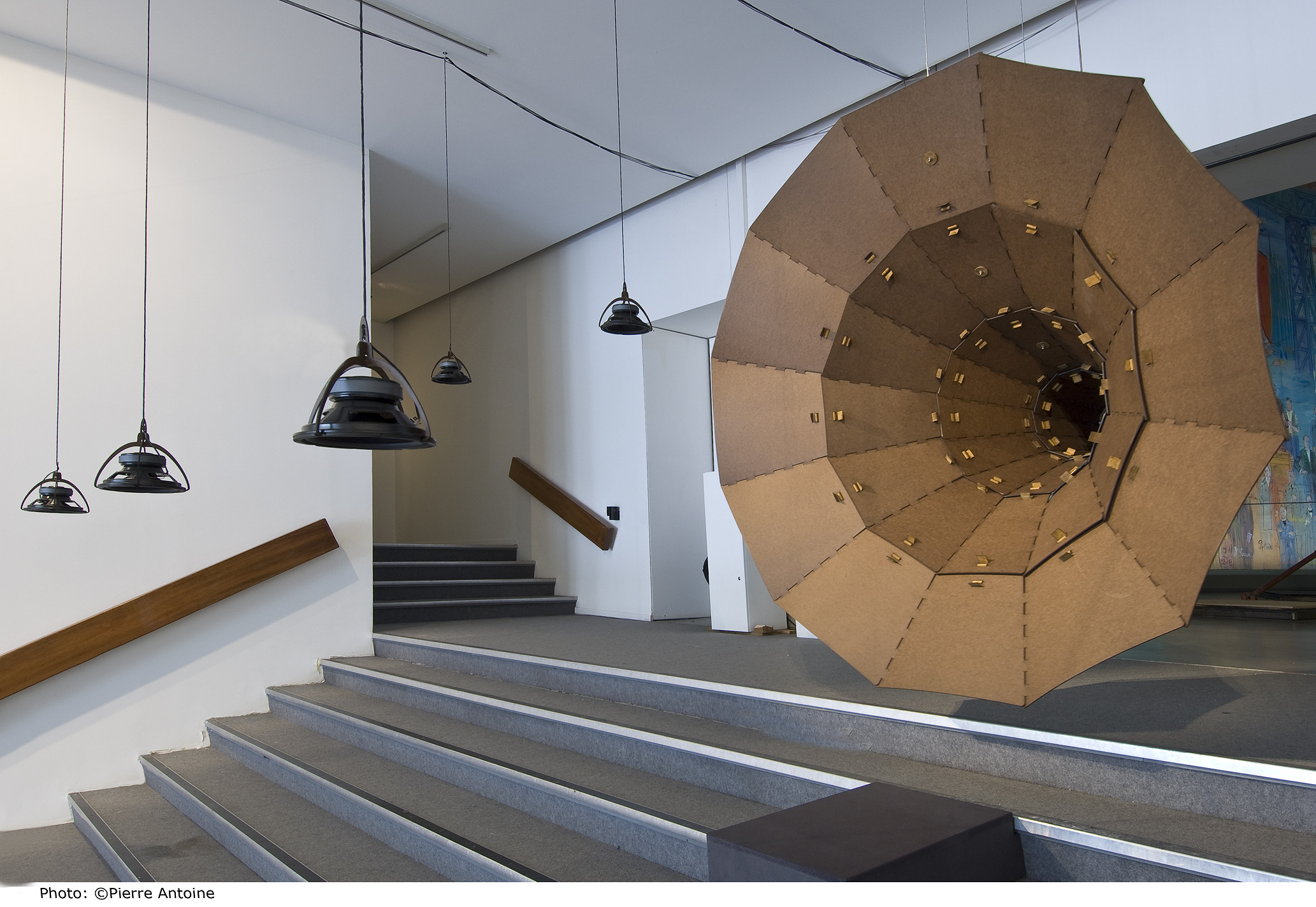
Tentative Call to the Other (2010) - installation
Architectural Sound installation with Ali Momeni for DYNASTY (June 10-September 5, 2010) commissioned by Musée d’Art Moderne de la Ville de Paris with support from the Council for Artistic Creation and the City of Paris.
A Tentative Call to the Other consists of a forest of suspended loud-speakers as well as a large speaker nearly 2m in diameter. The installation is situated at the entrance of the Dufy Hall at the Musée d’Art Moderne in Paris.
Within this immersive sonic environment, the visitor discovers the barrage of electromagnetic activity that surrounds us. Invisible but omnipresent, these signals are picked up with a special antenna placed on the roof of the museum. In parallel with the sonified electrical activity, visitors also hear sounds originating in outer space, picked up by ESA’s CoRoT Satellite, that are made audible in real-time thanks to a collaboration with Eric Michel from the Paris Observatory.
The diffusion of these sounds is punctuated by interviews with astrologers, hymns, and incantations of ritualistic prayers in Southeast Asian languages. This installation thus offers a contemporary reinterpretation of the painted mural by Raoul Dufy, La Fée Electricité (1937), itself a commentary on the impact of the urban electric grid human society.
Friday, 1 November 2013
Contact Mic
http://abduzeedo.com/sound-design-contact-mic-recording-and-water-foley
Concept: "Contact Mic Recording is a form of microphone specifically designed to pick up audio vibrations in solid objects. Normal studio mics are all built around the principle of detecting vibrations in the air but Contact mics are different in that they are designed to pickup surface vibrations."
http://vimeo.com/31926631
Thursday, 31 October 2013
Ice Bellows - Installation art by Nikki Pike
| "ICE BELLOWS (REMIX) |
| Ice Bellows (remix) began as a study of silence. The initial inquiry set out to capture the sound of ice melting to then amplify such subtlety, but the sound of ice as it melts became fascinating. In the process of amplification, the aural experiment grew quickly away from silence and shifted into a discovery of sound as the ice revealed a musical quality. The sounds came to life in the way Bjork performed a sort of factory musical in the feature Dancer in the Dark - each machine working together to create a composition. After analyzing and organizing the recorded sounds, a visual interface was erected. Viewers were then invited to manipulate these sounds through a simulated pipe organ. Thus, the viewer becomes the artist. Concurrently, a musical collaboration of the same sounds was in process with local jazz musician,Dan Schwindt. He arranged the captured sounds of ice melting to make a unique composition that serves as a foundational soundscape throughout installation and exhibit." Fonte: http://www.nikkipike.com |
Pulsu(m) Plantae _ project presentation
Artist Leslie Garcia has used transducers and amplifiers to translate the "language" of plants into sounds audible to the human ear.
In 1949, Roald Dahl wrote a short story called "The Sound Machine". In it, a man invents a machine that allows him to hear the sounds inaudible to humans due to their frequency outside the range of hearing, and discovers that plants do, in fact, make sound in response to the world.
Artist Leslie Garcia's "Pulsu(m) Plantae" has not, in fact, revealed that plants make noise. Instead, Garcia has analyzed the physiological response of plants to certain external stimuli and created a real-time "audio prosthetic" -- that is, a device that translates the plant's responses into audible sound.
She also found that the plants "hum" to each other when their vessels are connected. Just changing which plants are connected can change the quality of the sound.It consists of sensors to monitor the plants' biofeedback; a transducer (a device that converts those readings into sound); and amplifiers to play those sounds to the listener. Garcia found that plants emit different-sounding reactions to touch, sound, and light.
The idea that plants can "feel" is certainly not a new one; we can even see plants physically respond to light and water. Garcia's work, however, gives the concept an immediacy and sense of realness that may make you think twice before plucking a flower or walking on the grass when there's a perfectly serviceable path available.
Subscribe to:
Posts (Atom)